
October 29, 2025
Summary: Piloted in 2024 and promoted again in 2025, “SimpleFile” is the Canada Revenue Agency’s (CRA) response to the challenge of introducing automatic tax filing. But rebranding “File My Return” – an initiative launched in 2018 with consistently poor adoption rates – has not proven to be a winning strategy.
“SimpleFile” offers three filing methods: by phone, online and by mail. First, the CRA determines eligibility, relying heavily on prior filing history. This excludes anyone who has not filed a return in the past two or more years. Second, the CRA invites eligible participants by mail. Those without an up-to-date mailing address in the CRA’s database – including those of no fixed address or those who have moved recently – will not receive an invitation. Most participants are invited to use “SimpleFile by Phone” (a rebranded version of “File My Return”). This automated system has multiple weaknesses that together limit adoption to barely 5% of invitees.
The second article in this series examines what the CRA’s 2026 plans for “SimpleFile”. It argues that the invitation itself – rather than the underused filing methods – may become the vehicle for a significant shift in the CRA’s approach to automatic tax filing.

As restated in the 2023 federal budget, the aim of introducing automatic tax filing for low-income residents was to ensure that non-filers receive the benefits to which they are entitled.
Piloted in 2024, SimpleFile has been the Canada Revenue Agency (CRA) response to the government’s call for automatic tax filing. SimpleFile operates using three methods: by phone, online and by paper. Eligible individuals are sent invitations, encouraging them to use one these methods along with instructions on how to proceed.
I have looked at SimpleFile before, here and here.
Eligibility: who is invited – and who is excluded
To be invited to use SimpleFile in 2024 or 2025, individuals had to meet all the following criteria[i]:
- Low-income: Total income had to be helow a certain threshold (undefined) determined by factors such as age, province of residence and disability status.
- Simple tax situation: The CRA once described eligibility as requiring a “simple tax situation” that was contrasted with a complex one which would rule some individuals out. Yet none of the items in a complex tax situation produced a T slip, meaning the CRA could not determine eligibility from the slips alone. The CRA is now more explicit; a simple situation means income only from the following sources, all of which generate T slips: Old Age Security (T4A[OAS]), Guaranteed Income Supplement (T4A[OAS]), Canada or Quebec Pension Plan (T4A[P]), employment income (T4), Employment Insurance (T4E), workers’ compensation (T5007), social assistance (T5007), Canada Emergency Benefits (T4A), and some interest income (T5[box 13]).
- Consistency over time: The individual’s income situation had to remain unchanged from year to year.
- Filed a return: The individual must have filed at least one return in the two previous years.[ii]
What if the complexity lies not in a person’s tax situation but their benefits and credits? I will return to this question in the second article in this series.
This means SimpleFile currently excludes low-income individuals with complex tax situations, inconsistent income or no return filed in the past two or more years. That last criterion alone excludes many people who are not receiving the benefits to which they entitled. This runs counter to the government’s purpose for introducing automatic tax filing.
Invitations: who receives them – and who does not
Once eligibility is established, the CRA contacts individuals, inviting them to use one of the SimpleFile methods to file their return. The CRA does not publish data on the breakdown of its SimpleFile invitations by method. What follows is conjecture based on my experience and the CRA’s own public communications.
SimpleFile Digital: Those with access to their online CRA account.
As CVITP tax preparers know, most low-income individuals lack access to their CRA account. Reasons include limited awareness, lack of equipment (such as a laptop or internet connection) and poor digital literacy. As a result, paper mail remains the CRA’s main communication method.
SimpleFile by Paper: Very few individuals are invited to use this method. It is reserved for those on who have no history of filing and are allowed to have tax exempt income.
SimpleFile by Phone: Most individuals are invited to use this automated phone service.

Individuals who have provided the CRA with their current mailing address should receive their invitation. Most do this when filing their return, but they can also update their address by mail or phone.
If an individual has moved without updating their address, the CRA sends the invitation to the outdated address. Some may rely on postal forwarding, but others will never receive the invitation. The CRA does not publish data on undelivered invitations.
Another initiative targeting low-income non-filers – with a similar approach
For more than 10 years, the CRA has used a similar approach to reach out to previous non-filers, including those who have not filed for two or more years. Through its “Non-filers Benefits Letter Campaign”, the CRA has mailed letters promoting the benefits of filing a return, assuming that ignorance of those benefits is the main barrier. Yet this initiative has consistently produced questionable results.
The campaign has struggled in part because the CRA relies on the most recent mailing address in its database. As with SimpleFile, the CRA does not publish data on undelivered letters. Yet many non-filers likely have current addresses that differ from those on file.
Despite these problems, the CRA has not developed any effective alternatives to the postal system for communicating with non-filers.
Implementation results
In 2018 – two years before the federal government announced its intention to help non-filers access benefits through automatic tax filing – the CRA introduced a service called File My Return. When it launched the SimpleFile pilot in 2024, the CRA rebranded this service as SimpleFile by Phone.
Below are the adoption rates over time, first for File My Return and then, beginning in the 2024 tax season, for SimpleFile based on CRA public data.
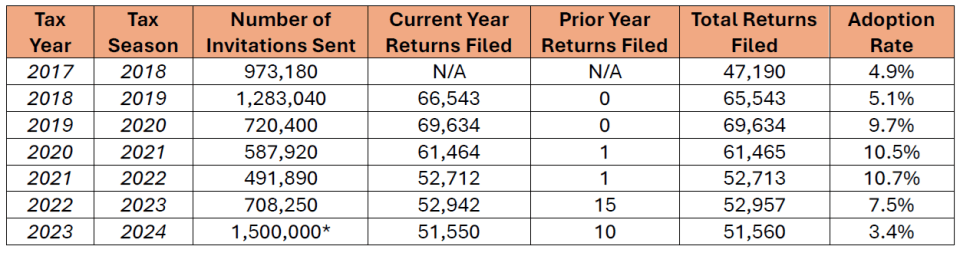
In the 2025 tax season, the CRA sent out 2 million invitations. While the 2025 tax season is far from over, we know the number of responses to date. As of October 13th, 83,640 returns had been filed using this method – an adoption rate of 4.2%.
These numbers are unlikely to change significantly before year’s end, since return filing – regardless of method – drops sharply outside the March-April peak season.
The published adoption rates for File My Return and SimpleFile show that, regardless of the name, the service is poorly designed to achieve the original goal of automatic tax filing.
Why has adoption been so low?

Although the CRA does not publish a breakdown of its SimpleFile invitations by method, it is reasonable to assume that most are for the automated phone service (as the CRA’s own communications suggest.)
Because the CRA communicates with most low-income individuals by regular mail, some never see the invitation if it is sent to an outdated address.
Those who do receive the invitation face several challenges:
- Trust and legitimacy: Some may suspect the letter is a scam, assume there is a cost, or distrust the CRA’s ability to secure all their benefits.
- Language and literacy: The invitation letter is long and written in English or French at a high school reading, which might make it hard to understand, especially people whose first language is neither one.
- Communication barriers: Automated phone menus can be confusing for seniors, people with disabilities, or those lacking proficiency in English or French. The system also cannot accommodate new income sources, deductions, or life changes.
Finally, there are people who prefer the human touch of a CVITP volunteer or a paid tax preparer.[iii] For those using the free CVITP service, there is no incentive to switch to SimpleFile. Through the CVITP, they can ask questions, receive explanations and build trust with volunteers.
Conclusion
CRA invitations to use SimpleFile are not reaching most chronic non-filers – that is, those not currently receiving benefits. Instead, they are being sent to low-income residents most of whom are up to date with their returns and already receiving benefits.

Contrary to CRA marketing, filing a return through SimpleFile is neither automatic nor simple to do. Only a small fraction of invitees uses the service, and the data show it is rarely used to file prior year returns.
In summary, SimpleFile is failing to achieve its original purpose: ensuring that non-filers receive the benefits to which they are entitled.
Regardless, the CRA seems to consider SimpleFile a success.[iv] The second article in this series examines what the CRA is proposing for SimpleFile in 2026.
[i] This is based on criteria posted on the CRA website until mid-2024. The SimpleFile criteria now posted on the CRA website are much less comprehensive. However, this does not imply that they are any simpler.
[ii] One does not need a filing history to receive an invitation to use SimpleFile by Paper. However, at least 75%, and probably a much greater percentage of the 2 million invitations sent out in 2024 were to use SimpleFile by Phone. As of this article’s publication date, there were no CRA data published giving the breakdown of SimpleFile invitations by filing method for 2025.
[iii] According to a recent Parliamentary Budget Officer study, of the 89% of File My Return invitees who chose another filing method in 2023, nearly half paid an EFILE service provider.
[iv] In an October 2025 online consultation, the CRA stated “The CRA has had success with its current automatic tax filing services.”